

Development and Application of Beam Moving Head Lights in Eurovision and Other Performances
Abstract: This article introduces the development and application of beam moving head lights, analyzing their use in performances such as the Eurovision Song Contest.
Keywords: beam light; spot light; wash light; Sharpy; light source; moving head light; light position
1 Development of Beam Moving Head Lights
Currently, moving head lights are commonly divided into three functional categories: spot lights, wash lights, and beam lights. Each type has its strengths, and together they create the art of light and shadow on stage.
Before beam lights appeared, moving head lights consisted of spot and wash types. Spot lights, which can focus and project patterns onto gobos, are the most common type, offering powerful features to create soft, clear, and colorful scenes, often used in narrative stage performances. Wash lights, without pattern focusing but capable of color mixing, are used for color washes.
Compared to spot and wash lights, beam lights emerged later. However, the concept existed in the scanner era (1990s), with simple color changers (equivalent to wash) and scanners with focusing lenses and scanning mirrors (equivalent to spot), and some even used prisms instead of scanning mirrors to achieve stronger beams.
Due to the limitations of scanners, moving head lights quickly took over the market, with VARI*LITE widely recognized as the first inventor. The Spot+Wash landscape persisted for a long time. In 2008, some manufacturers began using 1500 W Osram Lok-it system sources and Philips Fast-fit lamps. The lens at the lamp head differed from both Fresnel (wash) and plano-convex (spot) lenses, using a thin acrylic lens with fine threads. This lens, combined with the high brightness of the new source, produced a relatively uniform beam, marking the birth of the beam light.
Beam lights come in various types, typically with higher power for longer distances and lower power for shorter distances. For example, 1500 W beam lights are used in large outdoor shows or stadiums, while 300 W or 200 W units are used in theaters and studios.
Before beam lights, beam effects in performances were created using gobos in spot lights, especially in hazy atmospheres, but this was effective only within small areas, like 10 meters. In larger venues, the beam length and intensity were insufficient, especially with the increasing use of LED screens. The 1500 W beam light adapted to these changes, offering a beam intensity far superior to traditional spot lights, though still less than xenon searchlights. Searchlights often cannot be inverted due to waterproofing and structural constraints, limiting their movement range, whereas beam lights overcome this limitation.
After the 1500 W beam light, manufacturers introduced compromise versions with 1200 W double-ended and 1500 W double-ended sources, offering cost and size advantages but no substantial progress. However, the reduced size allowed designers to use beam effects in positions directly visible to the audience, such as the front of the stage.
Designer demand made miniaturization urgent. Technically, without a sufficiently compact new light source, achieving a parallel beam required a longer body (even longer than typical spot lights).
In 2010, Philips developed the 5R Platinum series source with an arc length of only 1 mm, about 1/7 of previous products. Traditional lamps required holes in the reflector, losing some light. The Platinum series source came with its own reflector, offering high reflection efficiency. Guangzhou Haoyang Electronics was the first to use the 5R source, developing the JT160 product. Later, Robe's Sharpy series adopted the same source but used a spot-like optical lens, while the former used an acrylic thread lens typical of beam lights. The optical lens is more expensive but produces a sharper beam.
With a smaller source, the lamp body could be significantly reduced, from about 50 kg (1500 W moving head) to over 10 kg. This increased movement speed, making "sharp" and "fast" major selling points. The beam angle is nearly 0°, achieving 30,000 lux at 20 meters, almost like a mini searchlight, yet as fast as a scanner, suitable for various music rhythms. Static beams allow audiences to focus on the singer, while rapid movements (color, position, intensity) match fast-paced music to create atmosphere. Even near LED screens, the beam remains visible, making the Sharpy a versatile workhorse in stage lighting.
However, the Sharpy and its clones have notable issues. The small size cannot accommodate traditional CMY color mixing systems, limiting color choices to a color wheel. The beam's focal point is outside the lamp head, and due to the straight beam, it remains in focus from the output to about 10 meters, posing fire risks. Signal cables, power cables, scenery, and costumes have been scorched, leading some theaters to consider banning heavy use of Sharpy lights. Despite this, Sharpy and similar lights are widely used, from talk shows to variety shows, from the London Olympics to weddings (see Figure 1).
.jpg)
Figure 1 Sharpy lights with a "Union Jack" design used in the Queen's Diamond Jubilee performance (the exterior was hand-painted by artists).
In the following 2-3 years, video was heavily used in stage performances, with backlight positions occupied by projection or LED screens, yet Sharpy lights were still widely used. Even without video, the fascination with beam-created dynamic stage spaces persisted, as the interplay and changes of beams are nearly infinite, allowing for countless spatial configurations with proper placement.
2 Eurovision Song Contest and Other Performances
2.1 Eurovision Song Contest
.jpg)
Figure 2 Scene from the 2012 Eurovision Song Contest
The extensive use of beam lights as effect fixtures was successfully demonstrated at the 2011 Eurovision Song Contest, and even more so in 2012. That year, video occupied more space, so beam lights were placed at the edges of LED screens to fit the compressed stage. Nearly one-third of the moving heads were beam-type fixtures, requiring close coordination between lighting and video to avoid obstruction. With 3,000 fixtures packed into a small area, both control and installation were challenging, but the lighting and video were equally impressive, ensuring each of the 40+ countries had distinct styles and unique lighting changes. The stage design remained largely unchanged except for a few scenes, so video and lighting were essential to differentiate each singer. Reportedly, the programming included over 4,000 cues (mostly beam changes) and nearly a hundred presets. In the 7-hour show, these designs provided rich variety. In reality, only a small portion of the 3,000 fixtures were visible on camera. From the light plot, fewer than 1,000 fixtures were above the stage. The photos mainly show Beam and Sharpy lights, with many Beam fixtures on the three concentric rings. Figure 2 shows the contrast between colored Sharpy lights and white 1500 W Beam lights, with the singer's backlight also provided by a 1500 W Beam (manually controlled by a crew member with the motor disconnected).
Additionally, many single-point backlights for performers were actually from followspots or manual Beam fixtures hidden above the stage (often mistaken for regular beam lights).
Table 1 Partial fixture list for the 2012 Eurovision Song Contest
| Fixture Model | Quantity |
|---|---|
| Clay Paky Alpha Wash 1500 | 78 |
| Clay Paky Alpha Shotlight 1500 | 22 |
| Clay Paky Alpha Beam 1500 | 157 |
| Clay Paky Alpha Spot 1500 | 249 |
| Clay Paky Alpha Profile 1500 | 47 |
| Clay Paky Sharpy | 114 |
| GLP Wash One | 129 |
| GLP Impression RZ120 | 30 |
| Martin MAC 2000 XB | 436 |
| Martin MAC 101 LED Wash | 142 |
| A&O Xenon Flower 7000 | 24 |
| A&O Xenon Beam 7000 | 37 |
Beam lights can create appropriate light ratios in both extreme cases of LED screens on and off, a feature not common to all moving heads. As shown in Figure 3, the combination of 1500 W Beam lights at the top and Sharpy lights at the bottom created depth and fullness (the beams appear bluish due to Sharpy's 7800 K color temperature). When the large screens were off, the beams alone created a sense of deep space, masking the dark screens.
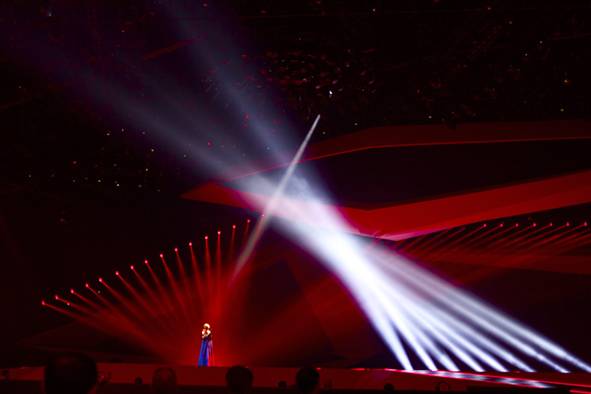
Figure 3 Scene from the 2012 Eurovision Song Contest (top 1500 W Beam and bottom Sharpy combination)
The irregular LED screens provided strong visual impact, and the unconventional light positions made the stage look more three-dimensional. Although the ceiling height was lower than in 2011 (30 m in 2011 vs. 16 m in 2012), the broadcast didn't feel cramped. With the low ceiling, the 1500 W Beam lights and the Sharpy lights in the rear had to work together to create an illusion of depth, and the Beam lights' beam shapes appeared more striking.
The 2013 Eurovision Song Contest introduced new changes. The stage was still magnificent, with a long, deep stage and a gem-patterned curved surface at the rear. Visual effects alternated between extensive projection and dimming to highlight the singers. The set's texture allowed simple washes to enhance the visuals, and the large curved projection screen accommodated multiple camera angles. In this true 360° stage, some singers began with their backs to the audience, yet the TV images always showed perfect framing.
The number of fixtures was significantly reduced compared to 2012, partly due to the use of projection. In 2012, there were 157 1500 W Beam and 114 Sharpy lights; in 2013, 200 Sharpy and 75 SharpyWash lights were used. Forty SPOT QWO800 fixtures were placed in the voting area. There were 179 spot and profile fixtures.
Table 2 Partial fixture list for the 2013 Eurovision Song Contest
| Fixture Model | Quantity |
|---|---|
| SHARPY | 200 |
| SHARPY WASH | 75 |
| GlowUP STRIP 100 | 50 |
| ALPHA BEAM 1500 | 50 |
| ALPHA PROFILE 1500 | 50 |
| ALPHA SPOT HPE1500 | 129 |
| ALPHA SPOT QWO800 | 40 |
| A.Leda K10 | 58 |
| A.Leda K5 | 49 |
.jpg)
Figure 4 Stage design of the 2013 Eurovision Song Contest (the diamond-patterned background at the rear could be used for projection)
.jpg)
Figure 5 Scene from the 2013 Eurovision Song Contest
2.2 London Olympics Opening and Closing Ceremonies
Similar examples abound. The London Olympics opening and closing ceremonies used 350 Sharpy lights installed in the rear seating area, creating deep beam effects. The beams were so thin that even crossing the audience's LED screens, they acted more like outlines, not disrupting the screens' overall effect (see Figure 6).
.jpg)
Figure 6 Scene from the London Olympics closing ceremony (Sharpy beams projected from the rear of the second tier across about 60 meters to the track)
.jpg)
Figure 7 Light positions in the rear seating area of the London Bowl (Sharpy lights were suspended with extension poles to avoid close-range projection onto the flag membrane, preventing heat damage)
Syncrolite 4 kW searchlights were installed under the triangular trusses at the edge of the London Bowl, but they were used sparingly, possibly because their beam impact was too strong and intrusive. In contrast, Sharpy beams, like fine pencil lines in a sketch, were used frequently. The 1500 W large fixtures at the bowl's edge were the backbone of the performance lighting.
3 Crossover Moving Head Lights
To meet diverse performance needs, many crossover products have emerged, capable of both beam and wash functions. The SharpyWash is one such example. It has the same size as the Sharpy, but the spot lens is replaced with a wash lens, and a retractable barn door is added, maintaining its compactness and lightness. It uses a 330 W 15R Platinum source with a zoom range of 6° to 48°, allowing it to be used in the same area as Sharpy lights for consistency, and then separately for other scenes. This crossover design suits the current trend of limited light positions.
Objectively, this light is a wash light; it doesn't produce a clear beam or many beam shapes, but at its narrowest angle, it can "act" as a softened Sharpy. It is best suited for exposed top lighting and slightly rear positions, often used as top light and occasionally as backlight. This versatile product offers a good option for many users.
.jpg)
Figure 8 The SharpyWash and Sharpy have the same dimensions.
If we look at the 2013 CCTV Spring Festival Gala, the top and backlight positions were surrounded by LED, leaving only small gaps for fixtures. Using SharpyWash-type lights might have alleviated the space constraints in those areas.
4 Conclusion
Today, the entertainment industry has embraced beam lights with great enthusiasm, and these fixtures have rewarded the investment. As a medium of visual art, beams are designed in conjunction with performers, scenery, and video. The real challenge is integrating and controlling beams with stage performance. All lighting, video, and stage design should serve the inherent requirements of the performance and the atmosphere. Whether moving heads will remain divided into spot, wash, and beam, or new types will emerge, deserves our careful consideration and attention.
“I Have a Dream” – MG Mask 2014 Annual Party

Tuoyuan PR & Media Helps SANY Shine at Las Vegas Trade Show

Event Management and Creative Strategies for Corporate Award Ceremonies

Brand: The Core of Corporate Value

Sochi Winter Olympics Closing Ceremony: Using...

Four Key Points and Considerations for Corpo...

Key Points of Event Planning

Development and Application of Beam Moving H...
5th China Real Estate Annual Conference Held in Guangzhou in 2013
MediaTek True Octa-core Smartphone Processor Mainland Launch Event
TOWIN News